
Isochronic tones: periodic pulses, envelope ramps and research
Isochronic tones are regularly repeated tone pulses produced by changing the amplitude of an audible tone. Because the on/off rhythm is shaped directly into the waveform amplitude, the pulses can be heard over both headphones and speakers under suitable carrier, level, and listening conditions.
1. How the sound works: Periodic amplitude pulses and ramp shaping
Isochronic tones are regularly repeated tone pulses produced by changing the amplitude of an audible tone. Unlike binaural beats, which arise from central processing of two slightly different frequencies presented separately to each ear, or monaural beats, which arise from the physical interference of two close frequencies, an isochronic stimulus uses a single carrier frequency fc (or chord) multiplied by a periodic gating envelope G(t) repeating at a pulse rate fpulse = 1/T:
x(t) = A · G(t) · sin(2π·fc·t)
The shape of the pulse envelope G(t) strongly affects the acoustic spectrum of the signal. If a tone is switched on and off by an unsmoothed rectangular gate Grect(t) (a step function jumping between 0 and 1), the envelope itself has instantaneous step discontinuities. If a rectangular gate switches when the instantaneous carrier amplitude is nonzero, the waveform x(t) jumps discontinuously in amplitude; even when the gate boundary coincides with a carrier zero-crossing (as at t = 65 ms and t = 165 ms for a 200 Hz sine carrier gated at d = 0.65), the first derivative dx/dt jumps discontinuously from 2πfcA to 0. Both amplitude jumps and slope discontinuities exist in the mathematical signal itself and spread high-frequency sideband energy ("spectral splatter") above and below the carrier frequency (Smith, 2010; Moore, 2012).
To reduce abrupt waveform transitions, audio synthesizers and laboratory stimulus generators apply gradual onset and offset ramps to each pulse. Different ramp shapes provide different orders of mathematical continuity (Smith, 2010):
- Linear (trapezoidal) ramps: Remove instantaneous amplitude step jumps (achieving continuous amplitude, C0), but retain first-derivative (slope) discontinuities at the corners where the ramp starts and ends.
- Raised-cosine (Tukey/Hann) ramps: For the raised-cosine ramp defined below, 0.5·(1 − cos(π·p / e)), both the envelope amplitude and its first derivative are continuous (C1 continuity, with zero slope at both endpoints) where the ramp joins the silent gap and the flat plateau, causing high-frequency sidebands to roll off more rapidly than with rectangular or trapezoidal gates.
Gradual onset and offset ramps reduce abrupt waveform changes and the associated high-frequency sideband energy, though they do not guarantee that every generated or reproduced sound is free of audible artifacts. Whether an unsmoothed gate produces an audible click in practice depends on the instantaneous carrier amplitude and slope at the switching instant, the playback level, and the high-frequency response of the headphones or loudspeaker.
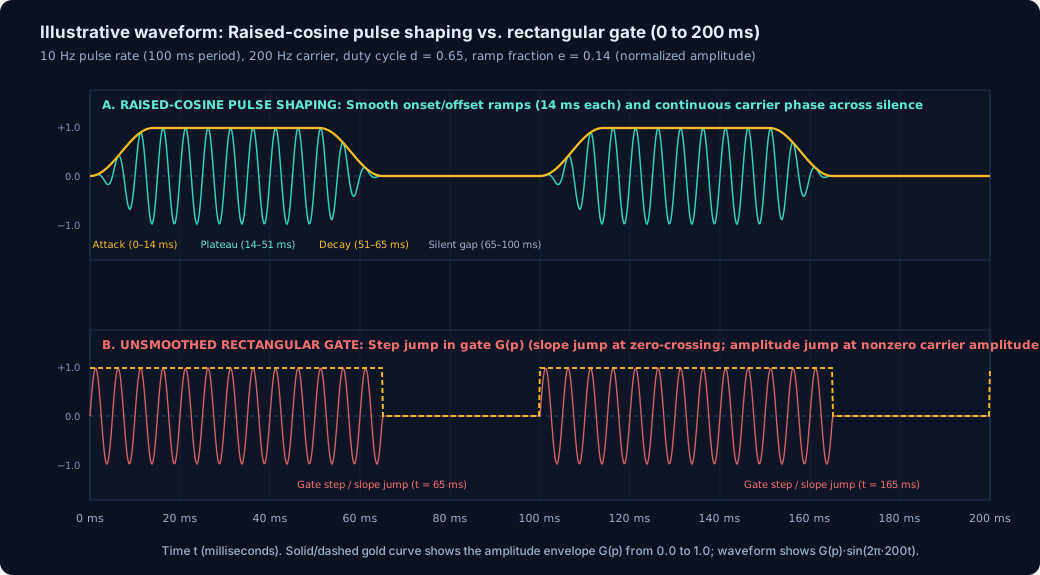
Mathematical details: Raised-cosine pulse model, duty cycle constraints, and AM sidebands
In a standard raised-cosine (Tukey-windowed) pulse model, let p = (t · fpulse) mod 1 ∈ [0, 1) denote the normalized cycle phase, d ∈ (0, 1) the active duty cycle (the fraction of each period where the pulse is non-zero), and e > 0 the fraction of the period devoted to the cosine onset ramp and cosine offset ramp:
G(p) = 0.5·(1 − cos(π·p / e))  for 0 ≤ p < e
G(p) = 1.0                      for e ≤ p < d − e
G(p) = 0.5·(1 + cos(π·(p − (d − e)) / e))  for d − e ≤ p < d
G(p) = 0.0 for d ≤ p < 1- Non-overlapping ramp constraint: For this piecewise definition to have a valid non-negative flat plateau between the onset and offset ramps, the ramp fraction e and duty cycle d must satisfy 2e ≤ d. If a synthesis model additionally requires a non-zero silent interval of at least 1 - d ≥ 2e, that is a design choice of that specific parameterization.
- Modulation depth parameter (D) vs. classical Michelson contrast (m): If an envelope mixes a steady floor with a pulsed gate via A(p) = (1 − D) + D · G(p) for D ∈ [0, 1], then Amax = 1 and Amin = 1 - D. In that specific parameterization, the classical Michelson contrast is:
Both m = 1.0 (100% modulation) and D = 1.0 coincide when the silent gap reaches zero (Amin = 0).
m = (Amax − Amin) / (Amax + Amin) = D / (2 − D) - Frequency-domain sidebands: Because G(t) is periodic with fundamental frequency fpulse, its Fourier series G(t) = c0 + Σ 2|ck|·cos(2π·k·fpulse·t + φk) multiplies sin(2π·fc·t) to produce symmetric sideband pairs at fc ± k·fpulse (k = 1, 2, 3, …). For a rectangular gate, sideband magnitudes decay slowly as O(1/k); with raised-cosine ramps of duration e/fpulse, higher-order sidebands above k ≈ 1/e roll off much more rapidly as O(1/k3) (Smith, 2010).
2. How it is perceived: Pulse salience vs. listening comfort
When each pulse in an isochronic train is separated by a distinct quiet interval, the envelope depth approaches 100%. Under suitable carrier frequencies, playback levels, and room acoustics, the rhythmic pulsing is perceptible over both stereo headphones and open-air loudspeakers.
- Onset salience in the auditory pathway: Auditory nerve fibers and brainstem neurons exhibit strong onset responses when a sound rises from silence after a brief gap (Moore, 2012). Consequently, discrete tone pulses feel much more pronounced than the subtle wavering of dichotic binaural beats.
- Trade-off between rhythmic sharpness and listening comfort: While a deep, rapid pulse train (10 to 40 Hz) provides a crisp rhythmic cue in short laboratory tests, some listeners find unmasked repetitive tone pulses fatiguing or intrusive during extended listening, leading many practical audio designs to soften the ramp slopes, lower the carrier pitch, or blend the pulses with background noise.
3. What research shows: Steady-state brain responses vs. clinical trials
In auditory neuroscience, periodic click trains, tone pips, and amplitude-modulated tones have been studied for decades as probes of the auditory steady-state response (ASSR), while clinical trials of consumer-style "isochronic tones" for mood, cognition, or anxiety remain comparatively sparse:
- 40 Hz and rate-dependent laboratory responses (Galambos et al., 1981; Pastor et al., 2002): Galambos et al. (1981) demonstrated that repetitive auditory stimuli near 40 Hz elicit a prominent steady-state evoked potential in human scalp recordings. To map how auditory cortex responds across stimulation rates, Pastor et al. (2002) recorded scalp EEG in n = 28 healthy volunteers across 12 click stimulation rates from 12 to 60 Hz (12, 20, 30, 32, 35, 37.5, 40, 42.5, 45, 47.5, 50, and 60 Hz) and conducted H215O positron emission tomography (PET) measurements of regional cerebral blood flow (rCBF) in a subgroup of n = 9 volunteers across four selected rates (12, 32, 40, and 47 Hz), observing peak steady-state oscillation amplitude and primary auditory cortex rCBF around 40 Hz. These foundational experiments used click trains to study sensory encoding, not wellness outcomes.
- Test–retest reliability of 40 Hz EEG ASSR stimuli (McFadden et al., 2014): In a scalp electroencephalography (EEG) test–retest reliability study in n = 19 healthy adults tested across two sessions approximately one week apart, McFadden et al. compared 40 Hz amplitude-modulated white noise against 40 Hz click-train stimulation, showing reproducible 40 Hz steady-state EEG responses while noting that stimulus characteristics influence response magnitude and between-session reliability.
- Experimental EEG comparison of rhythmic stimuli (Dos Anjos et al., 2024): In a single-session experimental EEG study of n = 28 healthy adults comparing 4-minute epochs of an isochronic-inspired rhythmic tone stimulus (ITd), gamma binaural beats, and white noise, the authors reported frequency- and region-specific scalp spectral power changes during stimulation without testing clinical symptoms or behavioral task performance.
- Randomized dental surgery anxiety trial (O. Akkurt & Ekici, 2026): In a three-arm randomized clinical trial of 90 adults (30 per group: binaural beats, isochronic tones, and no-audio control) undergoing impacted lower third-molar extraction under local anesthesia, the authors found no statistically significant between-group differences in preoperative or postoperative anxiety across MDAS, DFS, STAI-S, or VAS scales. Isolated physiological differences were observed only at single intraoperative timepoints (lower mean respiratory rate during local anesthesia in the isochronic-tone group, p = 0.015; lower mean systolic blood pressure during incision in the binaural-beat group, p = 0.041), while 78.3% of patients in the audio groups reported they would prefer auditory stimulation during future dental visits.