
Monaural beats: physical superposition, perception and research
Monaural beats are produced when two close frequencies are summed before reaching the ear. Because the resulting amplitude modulation is physically present in the sound wave, it is heard on both headphones and loudspeakers and drives a clear cochlear envelope response.
1. How the sound works: Physical two-tone superposition
Monaural beats occur when two sinusoidal tones of slightly different frequencies (f1 and f2) are physically combined before they reach the cochlea, either by summing them inside an audio circuit or by letting sound waves from two sources mix in the air (Moore, 2012; Schwarz & Taylor, 2005).
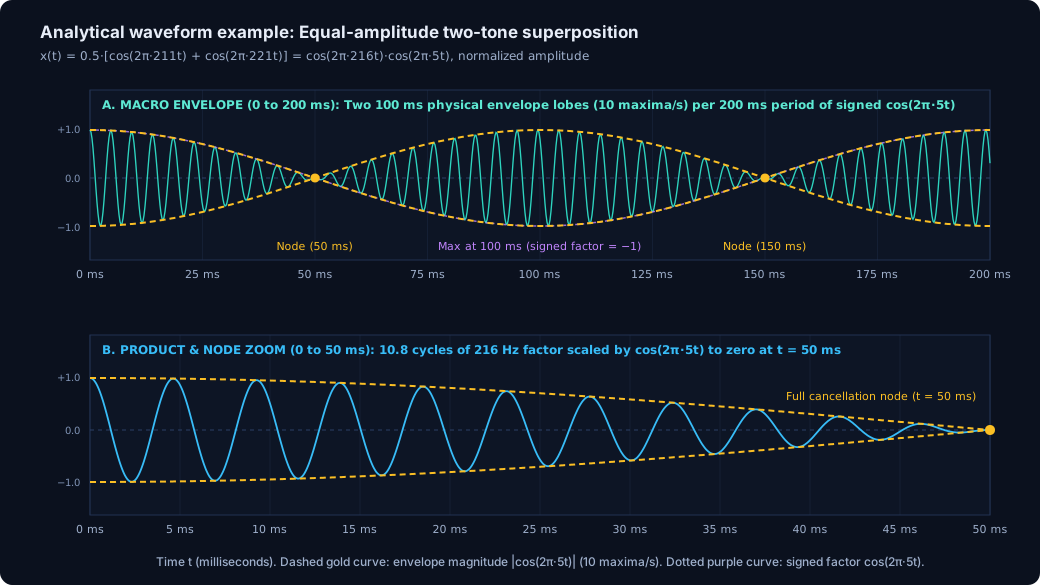
For two equal-amplitude cosines normalized by 0.5 so the peak excursion does not exceed 1.0, the combined signal is:
x(t) = 0.5·[cos(2π·f1·t) + cos(2π·f2·t)] = cos(2π·((f1 + f2)/2)·t) · cos(2π·(|f2 − f1|/2)·t)
For f1 = 211 Hz and f2 = 221 Hz, the rapid cosine factor in the product representation has frequency favg = 216 Hz (completing 216 cycles and 432 zero-crossings per second), while the signed slow cosine factor cos(2π·5t) oscillates at 5 Hz. Because the unsigned envelope magnitude |cos(2π·5t)| reaches two peaks during every 200 ms cycle of the signed 5 Hz factor (one where the factor is +1 and one where it is -1), the physical amplitude envelope repeats at fbeat = |f2 - f1| = 10 Hz (ten physical envelope maxima per second, spaced every 100 ms; perceived as a 10 Hz loudness fluctuation when both tones lie within a single cochlear critical band).
Mathematical details: Equal vs. unequal tone amplitudes
Complete destructive cancellation down to zero at the beat nodes occurs only when both tones reach the ear with equal amplitude (A1 = A2). If the two tones have unequal amplitudes A1 ≠ A2, the unnormalized sum x(t) = A1cos(2π f1 t) + A2cos(2π f2 t) has an analytic envelope:
E(t) = √(A12 + A22 + 2·A1·A2·cos(2π·(f2 − f1)·t))which fluctuates between a maximum of A1 + A2 and a non-zero minimum of |A1 - A2| (or 0.5(A1 + A2) and 0.5|A1 - A2| when normalized by 0.5). The beat rate remains |f2 - f1|, but the depth of modulation becomes shallower as the two amplitudes diverge.
2. How it is perceived: Cochlear envelope encoding and playback hardware
Because the amplitude modulation of a monaural beat is physically present in the acoustic pressure wave entering the ear canal, both tones excite overlapping regions of the basilar membrane whenever Δf lies within a cochlear critical band (Moore, 2012). Inner hair cell transduction rectifies and low-pass filters this mechanical envelope, encoding the beat rhythm directly into auditory-nerve firing rates in a single ear.
- Headphones and speakers both preserve the rhythm: Unlike binaural beats, monaural beats do not require left–right ear isolation. They can be heard through a single earbud, stereo headphones, or open-air loudspeakers.
- Sensitivity across carrier frequencies: Because the beat is encoded as an amplitude envelope at the cochlea rather than depending on brainstem interaural phase comparison, monaural beats remain audible at higher carrier frequencies where dichotic binaural beats fade (Perrott & Nelson, 1969; Schwarz & Taylor, 2005; Moore, 2012).
- Effect of transducer frequency response: Many compact transducers (such as built-in phone or laptop speakers) roll off at low bass frequencies depending on driver size and enclosure acoustics. If f1 and f2 are placed low in a region where a transducer's frequency response slopes steeply, one tone may be reproduced slightly louder than the other (A1 ≠ A2), reducing the depth of the destructive nodes without changing the beat rate |f2 - f1|.
3. What research shows: Stronger steady-state responses vs. behavioral outcomes
In human neurophysiology, monaural beats are frequently used as a physical benchmark against which dichotic binaural beats are compared:
- Larger auditory steady-state responses in comparative studies (laboratory response): Comparative electroencephalography (EEG) and magnetoencephalography (MEG) experiments examining 40 Hz and theta-rate beats report that monaural beats evoke larger auditory steady-state response (ASSR) amplitudes than dichotic binaural beats at the same difference frequency (Schwarz & Taylor, 2005; Orozco Perez et al., 2020), while MEG source modeling localizes both central (binaural) and peripheral (monaural) beat responses to auditory cortex (Draganova et al., 2008). This difference aligns with both peripheral auditory physiology and psychoacoustics: a physically amplitude-modulated wave drives synchronous cochlear envelope encoding directly (Moore, 2012), whereas dichotic binaural beats produce much shallower perceived modulation salience at matched beat rates (Grose et al., 2012).
- Why a larger ASSR does not prove clinical or cognitive benefit (Orozco Perez et al., 2020; Chaieb et al., 2015): A larger steady-state peak in the auditory cortex confirms that auditory neurons are tracking the physical envelope fluctuations of the sound. In a controlled head-to-head comparison of 7 Hz theta and 40 Hz gamma monaural and binaural beats around ~400 Hz carriers (N = 16), Orozco Perez et al. (2020) found that both beat types elicited subcortical carrier-frequency FFRs and cortical beat-rate ASSRs (with larger ASSRs for monaural beats in the tested conditions), while functional connectivity patterns differed with beat frequency and stimulus type without supporting broad state entrainment; however, no statistically significant change in self-reported mood on the Profile of Mood States (POMS) was detected, and behavioral vigilance was not tested.
- Home pre-sleep comparison (Shumov et al., 2023): In a counterbalanced home bedtime study (221 enrolled / 202 analyzed) where each participant completed three evening attempts listening to monotonous background sound with monaural beats, binaural beats, or sham audio without beats, behavioral sleep-onset latency did not differ significantly across the three conditions (repeated-measures ANOVA p = 0.21; pairwise adjusted p = 1.0).